


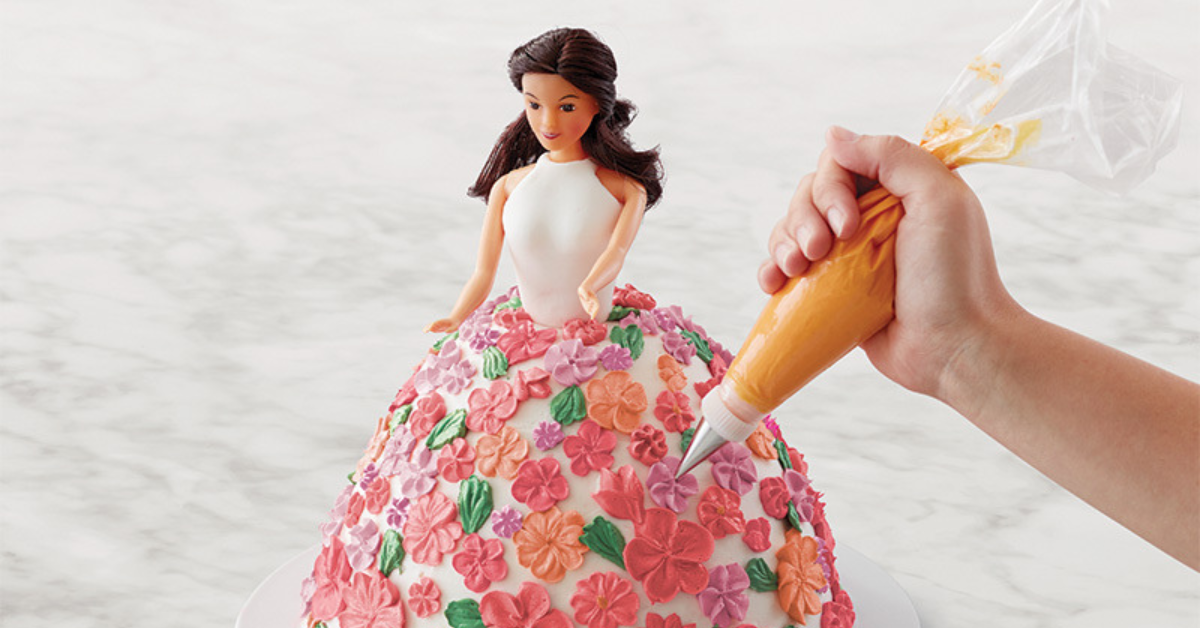
In the late ’90s and early 2000s, fancy doll sponge cakes with elaborately piped Technicolor buttercream petticoats and plastic Barbie heads were a staple of pastellerias and quinceañeras, and often graced bakery windows. These are the memories I share with many Latinos from my upbringing in Tijuana, Baja California, in northern Mexico. It was half edible, half ornamental, and completely symbolic. Although such ultra-feminine tiered cakes are less common today, their origins and continued creation still leave room for nostalgia and memory.
Puppet toppings on conical layer cakes may have been popular in the ’80s and ’90s, but they’ve proven to have a role in Latin American pastry for decades before that. In the 1959 cookbook Arte Mexicano del Azúcar, author Marite de Alvarado writes about the tradition of dhole cakes, especially for quinceañera celebrations. “When celebrating a girl’s 15th birthday, it is tempting to present this cake with (dolls) representing the characteristics of the girl’s debut in society,” de Alvarado writes. This book introduces a variety of cakes. Some of the dolls take center stage on the sheet cake, sitting in a frosting garden with their feet buried beneath buttercream florals. Other dolls are made of pastillage (sugar paste) and tower over a tiered cake in dresses tailored to the birthday girl, with powdered sugar cutouts of leaves and roses and real baby’s breath flowers on the bottom.
The quinceañera tradition as it is known in Mexico today was influenced by the French dance and elaborate dress culture that entered the region through the French invasion of 1862. During this time, Carlota of Belgium, the wife of the French emperor, held elaborate balls and dinners with desserts such as sorbets, puddings, and cakes baked by French chefs. As Mary Amberson explains in her book. Maximilian and Carlota: Europe’s last empire in Mexico. As expected, French influence was also felt heavily in 19th-century Mexican pastries, from olejas (a French take on palmiers) to cuernitos (a take on croissants).
The first recorded doll cake was originally inspired by the 1843 poem “The Corpse Going to the Ball” by American author Seba Smith, in which a young girl named Charlotte braves a frigid, snowy night to ride a sleigh to a ball, but (spoiler) freezes to death. When Germany began producing miniature porcelain dolls in the mid-19th century, they began morbidly calling them “Frozen Charlottes,” after a popular poem. Poor Charlotte was carried around as a totem of good fortune, and German bakers began to capitalize on the trend. baking Make them into a cake. Like Three Kings Bread, Rosca de Reyes, and Mardi Gras King Cake, they all have a baby doll doll hidden somewhere inside.
When Charles Dickens’ novel Barnaby Rudge was published in 1841, doll makers began making figurines of the protagonist’s love interest, Dolly Varden, and a cake craze soon followed. Dolly, a very Victorian woman with a wide-brimmed hat and colorful skirts pinned together in layers, sparked fashion trends and even cake trends. Although bakers didn’t recreate her lookalike, the rise of the “Dolly Varden cake” caused cake sales to skyrocket. Layered cakes in a variety of colors and flavors. jam. Around 1940, Queen Elizabeth started a trend in England for wedding cake toppers that used figurines of the bride and groom who shared the likeness of the couple to be married. Cake style has become instant strike.
Although the exact origins of Barbie Cake cannot be determined, the first Barbie doll was released by Mattel in 1959. It became an instant sensation and is thought to have pushed the existing doll cake genre forward. By the 1970s, the cake decorating brand Wilton made it much easier to create what became known as Barbie cakes, fairy tale cakes, or doll cakes. Wilton began selling dome-shaped cake pans with a thin cylinder in the center. wonder mold cake mold. I inserted this shape be Doll picks – pointy plastic picks that protrude from the doll’s body to stabilize the doll in the pastry pan – are simpler. Also, by using a cake pan, bakers were able to achieve the dome shape of the skirt in one baking, without having to cut and shape the cake layers. Finally, in the 1980s, the first official recipe for Doll Cake, known locally as Dolly Varden Cake, was published in The Australian Women’s Weekly’s Children’s Birthday Cake Book. Of course, the elaborately piped cake skirt is likely inspired by the Victorian skirt style of ornate, voluminous ruffles and draped crinolines, constructed with boning and bustle. 1850s.
How are Barbie cakes made today? Is there a pair of legs lurking under the buttercream, or is there a pair of legs in the bakery? A designated bucket with shiny toed doll limbs sticking out, toe side up? Janet Pastrana, the Puerto Rican baker behind Janet’s Cakes, a cottage bakery in Willimantic, CT – currently open only to Pastrana’s lucky friends and family in Bridgeport, CT; Janet La PiragueraIn the summer, we sell Puerto Rican shaved ice. He laughed at my bucket theory and quickly corrected me. She has been making doll cakes for quinceañera centerpieces since the height of their popularity in the ’80s and ’90s.
“Dolls usually don’t have legs,” she says. Pastrana said dolls used in cakes typically end at the waist; choose It is used to stabilize cake sponges and is aptly called a doll pick. Wilton still on sale Like many other companies, you can choose a doll, but people can also seek out eBay For vintage items. However, in the late 20th century there was a lack of diversity in the selection of Wilton dolls, so it was customary for Pastrana’s customers to provide their own Barbie dolls, legs, etc., as a visual representation of the birthday girl. This required surgical adjustments, whether in doll or cake form. Pastrana usually removes the legs first, because adding a whole Barbie doll could make the cake unstable. She began rethinking her methods after a young girl, horrified by the sight of a legless Barbie doll after cutting into a cake, returned to Pastrana and asked for her next doll cake to have legs.
Although this cake shape is widely accepted by Latinos coming of age for Quinceañera celebrations and other birthdays, it is clear that it is a nostalgic cake for many people around the world. Abena Anim-Somuah, Voice of Cherry Bombe Podcast The future of food is you and its author food friends Newsletter, celebrated her first birthday with a doll cake in Ghana in 1997. “My mom is a big fan of birthdays and celebrations,” Animsomua told me via text message. “This was my first birthday cake, and I think it was a big deal for a mother who had just given birth to her first child, her first daughter.” Anim Somua’s mother noticed her love for Barbie dolls and asked a friend to bake her a white buttercream doll cake with a pink border.
Food writer and vegan baker living in Singapore Gun Chin Lin According to her, doll cakes were a “standard” locally in the late 2000s and early 2010s. “I Lin said in a DM that her “low-cut” cake designs depicting Disney and Disney-adjacent princesses, featuring skirts and sometimes even mermaid tails, were popular at female friends’ birthday parties. But she was always surprised that Barbie was naked underneath the sponge and buttercream.
These famous doll cakes were inspired by last year’s Reddit thread “Who remembers the Barbie doll cakes at the grocery store?” They can still be purchased through cottage bakeries, local bakeries, and chain bakeries like Publix (starting at $79.99 for a blonde Barbie in a pink frosted skirt). Online, through TikTok, YouTube, and Instagram, doll cakes continue to interest and excite bakers and viewers alike who take them through the creation process from start to finish. From ultra-vintage-style Barbie cakes like Hannah Curry’s (@laretrorecipe) classic From chic ’50s dolls to more modern doll cakes like those created by Mirvat Hachem-Osseili.@bakemydaymimo (on TikTok) –– People who focus on Barbie dolls that reflect the beauty of little girls everywhere, like this one hijabi barbie cake — Crafts are alive and well.
However, although these cakes still occupy a special place among celebrations and pastries, they are no longer as popular as they once were. Wilton is also paying attention. “Although doll cakes are not as popular as they used to be, you can still see people preferring this type of cake, especially for birthday parties. Most often, they are made into doll skirts that are decorated with buttercream or fondant,” company representative Kristen Anillo-Dean wrote in an email.
This is especially true for modern girls who celebrate their Quinceanera. pastrana I started looking for more sophisticated cake styles, such as three-tiered cakes with fondant. Irma GarciaA custom cake baker in Chula Vista, Calif., says he doesn’t get requests for doll-shaped cakes. Lately, we’ve seen a surge in orders for cakes with three or more tiers, either reflecting the quince theme or in elegant, floral-decorated styles.
pastrana She may have noticed a decline in Barbie cakes back in 2005, but she still has one loyal doll cake customer. “I’ve baked a doll cake for her birthday every year since her first birthday,” she told me over the phone. The customer is turning 21 this year, and she was planning a 4-foot-tall cake with 20 miniature dolls from past cakes. Some of them have been saved, some of which she plans to repurchase, and all of them are set up as centerpieces on one tall cake. But this final challenge has been postponed because the soon-to-be 21-year-old is planning to go on a cruise for her upcoming birthday.
About pastranaher love and nostalgia for Barbie cakes never goes away. who knows? Maybe ordering a custom Barbie wedding cake is in her future.
Photo courtesy of Wilton
