


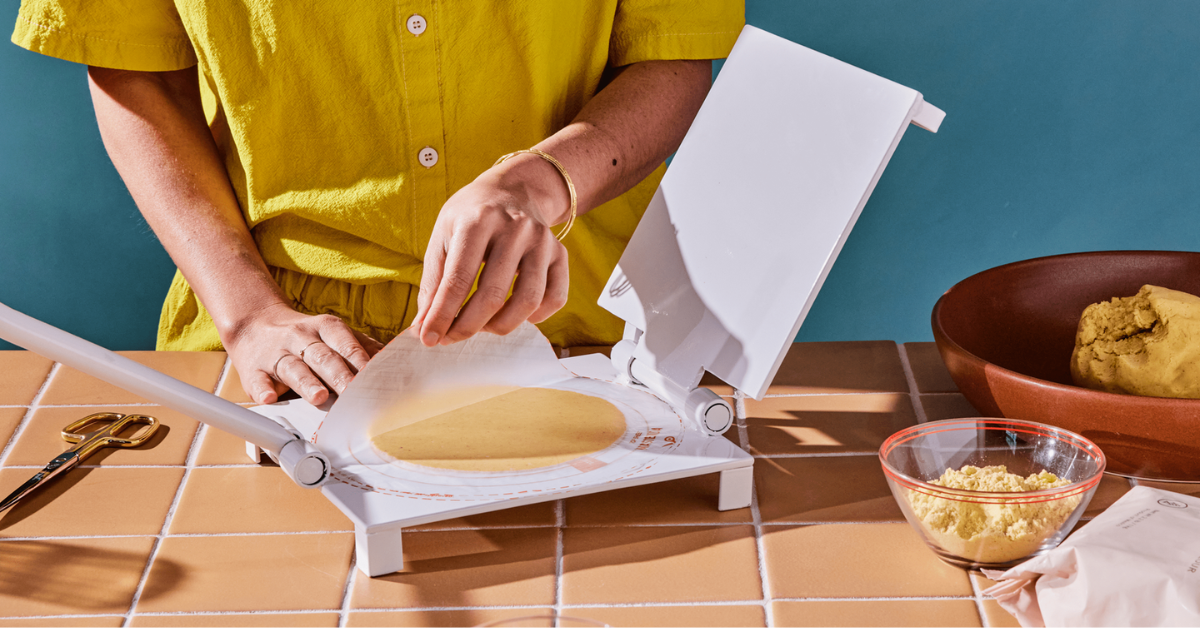
There are very few kitchen tools that have literally canonical names. For example, the knife has no explanation of its purpose. Blender, juicer, and food processor are close cousins, but these names describe the function and allow for unlimited input. A tortilla press, on the other hand, is also known as a tortilladora or plensa, an accurate name for the single task it is made to perform: pressing balls of dough into tortillas. That’s why I was surprised when the feeds on my Instagram Reels and TikTok For You page suddenly started filling up with brilliant, unconventional applications for over 100-year-old Mexican home appliances. Restaurant chefs and home cooks alike use this tool to press chicken for cutlets, beef for carpaccio, seafood for ceviche, and more. It’s a testament to ingenuity that the simplest devices can be reimagined to do more than what their inventors intended. How did we get here?
“So the first tortilla presses were by hand,” says Los Angeles Times columnist Gustavo Arellano. book About tacos. Arellano sees the tortilla press as a tool of industrialization, like the steam engine or the power loom, but not for Masa. This goes back to the first recorded Mexican restaurant, which he estimates is more than a century old. “If you just wanted to make lunch, breakfast, and dinner for your family, you didn’t need a tool to do what you wanted to do quickly. Tortillas were always made by hand using pin rollers, bottles, or the palm of your hand. Presses really took off in restaurants where they needed to create uniformity in terms of shape and volumetric thickness.”
Tortilla machines date back to the early 20th century and became increasingly automated over the next few decades, but today we’re talking about hand presses. Two heavy, flat-bottomed circular or square plates, most often made of wood or metal, attached by a hinge that allows pressure to be applied from the top plate to the bottom by pushing down on a handle, flattening anything placed between them. “This is a great device to destroy things,” Arellano says.
“I was immediately drawn to its practicality, sturdiness, and even beauty,” Jorge Gaviria says of the company’s popular high-end tortilla press. maciendaa company he founded. Masienda began by selling masa harina, made from single-origin heirloom corn, to restaurants in the United States and Mexico, and later expanded to include tortilla dolas. The product is Recently rated as one of the best products on the market Written by Serious Eats. Tortilla presses come in a variety of styles, shapes, and sizes, and they tend to vary by region of Mexico. Most presses you’ve probably seen are small, round, and made of cast iron or aluminum. macienda model Gaviria is a heavy 8-inch wide square rolled steel press that we first found at the Avastos market in Oaxaca in 2014. There he noticed that square press shapes were becoming more prevalent.
Tortilla Press works at the New York restaurant Cosme. Photo: Araceli Pass
Although Masienda now sells thousands of tortillas a year, Gaviria said it was the first customer he served them that inspired him to become a purveyor of tortilla presses. Enrique Olverachef and owner of a restaurant group that includes Mexico City’s Pujol. Cosmetics Two fine dining restaurants in New York not only serve every genre of cuisine on the planet, but they are also pioneering Mexican restaurants. Gaviria recalls that when Olvera saw Masienda’s square press, he immediately understood the impact it would have on the cooks in Cosme’s kitchen, which produces more than 1,000 tortillas a day from 35 kilograms of masa milled and milled in-house. That’s the rate at which one cook processes approximately 200 freshly squeezed comal-cooked tortillas per hour throughout Cosme’s five-hour jam-packed dinner service.
We spoke to the cosmetics chef de cuisine. Gustavo GarnicaHe has been working at the restaurant for over 10 years and talks about the role the tortilla press plays in daily operations. “Next to the molino, it is the most important tool in our kitchen. In New York, you can’t walk to a Best Buy or Bed Bath & Beyond to exchange.“Garnica says the size of the macienda press is needed because of its effectiveness and the options it offers. “It distributes the weight a little better than a circular one, you have more room to make the tlayuda, and you can press two tortillas at a time,” he told me.
Cosme Kitchen has been reluctant to change its tortilla dora for more than a decade, but it happened two or three times. “We maintain our equipment as best we can, but sometimes we have to replace it due to wear and tear, because it can break down to the point where one press is not enough, so it doubles our workload, slows us down, and leaves us exhausted in one service,” says Garnica. “But the tortilla women know what they like and what works for them. And when I suddenly show up with something new, it’s hard for them. I have a woman who’s been making tortillas for six or seven years. She loves the press and won’t use the new stuff. She said to me, ‘I’ll take this with me when I go home.'”
At Cosme’s Kitchen, we don’t limit the use of our presses to tortillas. It joins, along with several other flat vegetable dishes, to crush, or crush, plantains for tostones. Similar innovations are being promoted by food content creators jesse jenkinsShe grew up in Southern California before moving to London and combined her love of cooking and photography to build a social media presence with nearly 1 million followers between Instagram and TikTok. A kid from Los Angeles who grew up eating Mexican food and always had tortilla dora in the kitchen was the inspiration during development. This is a recipe for tuna carpaccio..
“For certain tuna dishes, you have to pound it out slowly to maintain its thickness and shape, and that’s a lot of work. One day I looked at a tortilla press and thought, ‘Why not use this?'” Jenkins says. “It applies incredible pressure, like a car jack. You just layer the fish or whatever between two sheets of plastic and the press does the work. It’s a lot of fun and anyone can do it.” Jenkins has turned his press experiments into a series that has been liked, shared and commented on by tens of thousands of followers across a variety of platforms. Some of the chefs told him that they incorporate press into their preparations for uses in non-Mexican restaurants, such as: Flatten the scallops for crudo or Lamb ribs for cutlets.
Although Jenkins is widely credited on social media as the first person to reimagine the tortilla press online, he is quick to acknowledge that it was used in a similar way at some point offline, perhaps by some inventive cook. “I didn’t invent anything, but I first put it on the Internet,” Jenkins said. Content creators and chefs around the world will continue to experiment with the humble tortilla dora to see what other magic they can wring from it.
Here is an example of how a non-traditional tortilla press was utilized before the virus outbreak. Kepike goodsis a new Bay Area condiment company inspired by chili vinegars from Central America and the Caribbean. To spread the word about Que Pique, Swain creates food videos. Photographed in the backyard for Instagram. He uses the ever-popular tortilla press to prepare seafood dishes, tostadas, choripan sandwiches and other dishes that go well with his signature chile vinegar sauce. But one of his most interesting videos is based on Toston, a recipe he learned from his mother many years ago.
in recent videosSwain uses a tortilla press to flatten the plantain chunks he fries first, then returns them to the oil for extra crunch. It’s a technique he borrowed from his mother, who started using a tortilla press for tostones several years ago, even though there are no tortilla presses in Nicaragua. “She says that in Nicaragua they use their hands to make tortillas because they are so thick, and for tostones they use the bottom of a soda or beer bottle,” Swain said. “My mother thinks[the tortilla press]came into our house about five years ago. I’ve never seen one in Nicaragua.” In this case, the Mexican tool has entered Central American kitchens in California as a kind of cross-cultural handshake, an underlying recognition that few tools are better at crushing ingredients than a tortilla dora.
This is not to say that tortilla presses are for every flat prep task in the kitchen. Jenkins ran into some bad luck in his pursuit of his next viral video. “There were so many things that could go wrong. The funniest one was when I thought I could make a crushed cucumber salad in a press,” says Jenkins. “It was a lot of pressure. It completely exploded everywhere. Either it didn’t work or I just didn’t get it right. Maybe someone else will get it right.” Given the innovation we’ve seen in recent months, it would be foolish to put a cap on what happens next.
Top photo provided by: Masienda
