


As an Ecuadorian writer who has spent years reading about American cuisine, I’ve always been surprised that Ecuador’s vibrant, textured cuisine hasn’t been in the spotlight yet. Dishes like green plantain empanadas stuffed with melty queso fresco and ceviche jipijapa with a silky peanut and citrus sauce are right there, ready to be the talk of the town. But even as other Latin American cuisines gain popularity in the United States, Ecuadorian cuisine remains consistently ignored.
There was an important moment of recognition, especially at the turn of the century. In 1998, food critic Jonathan Gold investigated the Ecuadorian rapingacho stand selling mashed potato fritters along Los Angeles’ Pico Boulevard in a restaurant column for LA Weekly, which often highlighted the underrepresented kitchens of Los Angeles’ immigrant communities. Anthony Bourdain famously said in Kitchen Confidential that the sharpest cooks in New York were Ecuadorians. Throughout the book, he praises their skills and work ethic, recalling his time as a chef at French restaurant Les Halles. You’d think the story would have expanded even further if the two media heavyweights had given it their blessing. But the truth is, Ecuadorian cuisine is still not even on the covers of magazines or in conversation.
Author Nicolas Gil, who has become one of the sharpest observers of the cuisine of the Americas through his New Worlder newsletter and interviews with major food publications, candidly states, “Ecuadorian cooks are the backbone of the American restaurant industry, but Ecuadorian cuisine itself is missing there. We hope that changes.”
The United States is home to the largest Ecuadorian community outside of Ecuador, with a total population of approximately 830,000 people. This is more than the people who make up the Peruvian and Argentinian communities in the United States, but the cuisines of these countries have had a far greater international influence. Although Ecuadorians’ own food traditions barely scratch the surface of mainstream American culture, this cuisine is incredibly diverse and full of character, with roots in the food traditions of the indigenous peoples of the Andes, Amazon, and Pacific Coast. The cuisine has been further shaped by Spanish colonization, enslaved Africans brought to Ecuador, and global trade with Asia and Europe.
The result is a deep and diverse regional cuisine. Ecuador’s Pacific coast is rich in seafood, plantains, peanuts, and coconuts. The unique style of ceviche is alongside a fragrant coconut seafood stew and mashed fried green plantain balls with fresh cheese and chicharrones. In the Andes, pork, corn and potatoes are king. Hornado, a crackling-skinned roast pig, is served with creamy rapingachos, orange-tomato dressing, fried ripe plantains for sweetness, avocado slices and hominy for palate cleansing, and tamarillo and lupini bean chili sauce for heat. “There’s still not a single dish that comes to mind for everyone, like Venezuelan arepas or Peruvian ceviche, but that’s not necessarily a bad thing,” Gil says of the broader conversation surrounding Ecuadorian food in the United States. “The cuisine is so diverse, so special, so regional, so location-specific that it’s hard to summarize.”
Cotoa dark chocolate lava cake with sea salt flakes and passion fruit sorbet. Photo: Alejandro von Lipke.
Amazon’s food is simple but still delicious. River fish and yuca are wrapped in banana leaves and grilled and served with local fruits and vegetables such as chili and garabato yuyo sprouts and grilled makambo seeds. This region is also the birthplace of cacao and has the richest cacao genetic diversity in the world, making Ecuador a world leader in fine chocolate.
Over the past 50 years, the arrival of Ecuadorians to the United States has been driven by economic and political crises, and more recently by growing anxiety about immigration within the country. Although many Ecuadorian communities are concentrated in New York’s tri-state area, other new immigrants have settled in cities such as Miami, Chicago, Los Angeles, Minneapolis, and Houston. Those who entered the country illegally survived by cutting off their cultural expression from public view and assimilating into American life. At the same time, Ecuadorians became an integral part of the American workforce, particularly in restaurant kitchens, food production, and agriculture.
“At work, I was able to connect with the Ecuadorian community in New York,” says Chef Michel Proaño. He works as a sous chef at French restaurant Le Coucou and has previously worked at Café Carmellini, Chef’s Table at Brooklyn Fair, and in the kitchen of Gabriel Kreuzer. “We really have a lot of people.”
Although Ecuadorians have literally helped feed America, their own cooking remains confined to homes, close-knit community gatherings, and small restaurants and informal food stalls that serve primarily other Ecuadorians. But recently, a new generation of immigrants has begun to claim space more openly through social media, restaurants, and cookbooks.
Keira Wright-Lewis is one of the few authors helping bring Ecuadorian cuisine to a wide audience in America. In her 2025 cookbook, My (Half) Latinx Kitchen, she reflects on her Ecuadorian and Korean upbringing, exploring the flavors inherited from her Ecuadorian grandfather. This book includes her take on typical Ecuadorian dishes
“Throughout my life in America, whenever I told someone I was half-Ecuadorian, the most common response was, ‘What is that?'” Those same questions now shape the work of Alejandra Espinoza, an Ecuadorian chef determined to bring her cuisine to a wider American audience. After opening Somos, a contemporary Ecuadorian restaurant in Quito in 2019, Espinoza and his family moved to Miami in 2023. In less than three years, she opened two restaurants in Miami. One is Cotoa, an Ecuadorian high-end restaurant that is currently Michelin-rated, and the other is Cotoita, which has a fast casual concept. Espinoza is currently preparing to expand Cotoa into a larger location by opening an Ecuadorian bakery called Ishpingo.
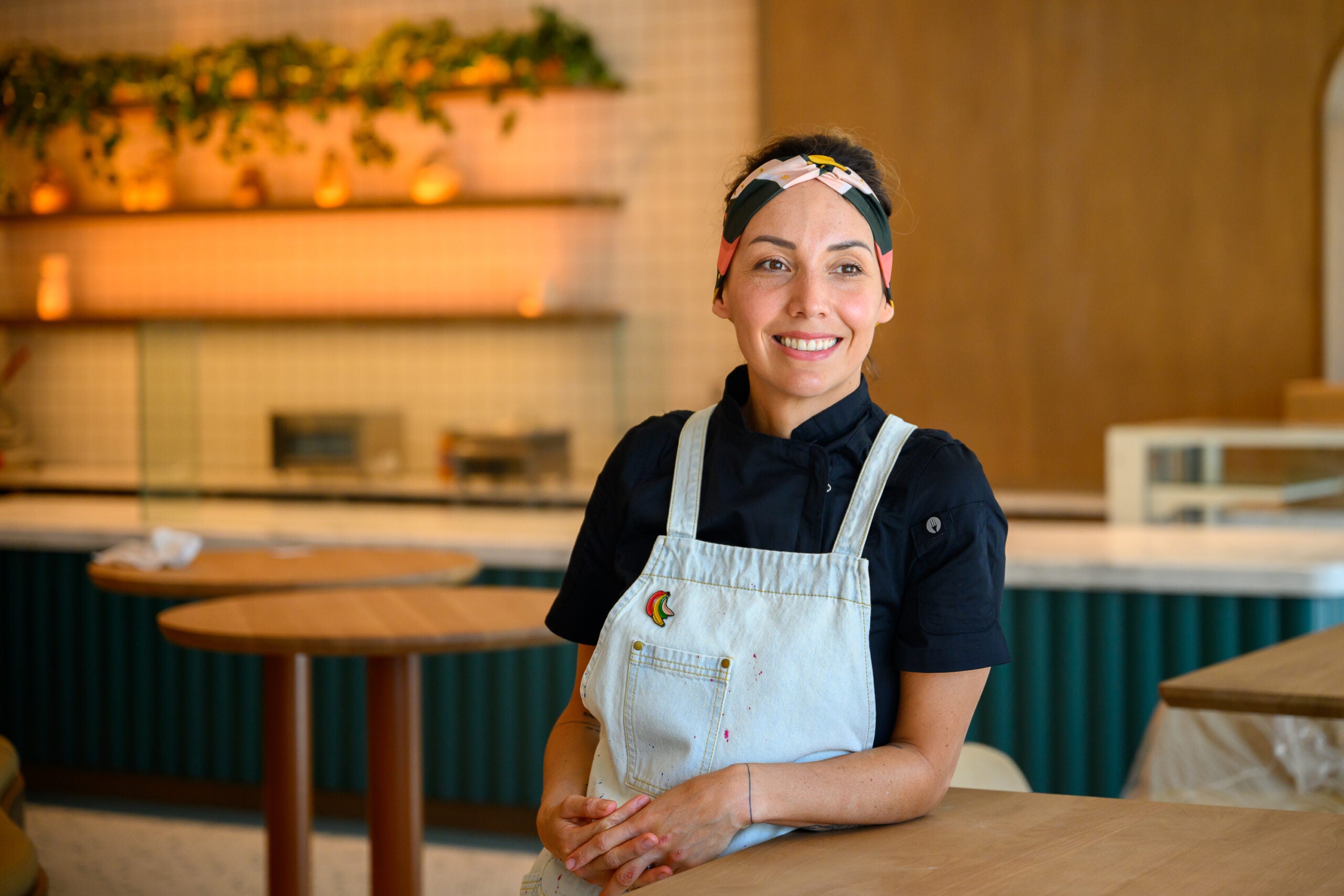
Chef Alejandra Espinoza of Cotoa.
Espinoza says there was initially little interest in her restaurant in Miami. Because the diners didn’t seem to know where Ecuador was on the map and, more importantly, what style of cuisine they could expect. However, over time, the unique flavor of the dish makes it stand out. “Our food is very colorful, and the flavors and textures set us apart from other cultures in Miami. When our customers try it, they see that our food is unique. It’s not the same as Colombian, Peruvian, or Venezuelan food,” Espinoza says. “We now have a diverse clientele of all nationalities. We’re bringing all of Miami together.” With that foundation established, she’s encouraged to expand the menu into more unconventional areas. “We recently made guinea pig dumplings, and we were able to do that because our customers understood us and gave us a chance. Customers trust us after first trying simpler dishes, such as Jipijapa’s peanut ceviche.”
For other Ecuadorian restaurants looking to expand their clientele beyond their existing communities, building relationships with diners is key. Fernando Cando, chef and owner of Leticia’s in Corona, Queens, has found an unexpected solution: tacos.
“There are a lot of Ecuadorian restaurants in Queens, but it has a very homey feel,” Cando says. “I saw an opportunity to present and promote our cuisine in a creative way, not only to Ecuadorians, but to a global audience. I created a section of the menu for tacos that would be approachable and easy to eat for foreigners, using Ecuadorian ingredients like hornado, tripa mischqui, and guatita, and presenting them as small bites instead of forcing people to order a large main dish.” Cando Although the tacos aren’t currently the most ordered item on his menu, he believes they’re helping him attract new customers. In 2022, restaurant critic Pete Wells visited Letizias and it received an added boost when it was named a New York Times critic.
For Ecuadorians in Queens, picking up a cup of warm morocho or empanada from a street vendor, alongside a weekend of soccer or volleyball cancha, remains an essential way to maintain community. But these practices are changing as ICE’s mass deportation campaign deeply impacts the Ecuadorian diaspora in the United States. Sonia Guignanzaca, an Ecuadorian-born Kichwa-Canali indigenous poet and cultural strategist, grew up in Queens and frequented spaces like this to connect with her culture. “Right now, in areas that have been hit hard by ICE raids, people are afraid to go out,” Ginyansaka said. “If you’re an Ecuadorian restaurant owner, it’s difficult (to keep your restaurant open). Three years ago it was different. I think people are doing their best to maintain a connection to their homeland through food, but (many of them) are staying indoors, safe and protected from the ice.”
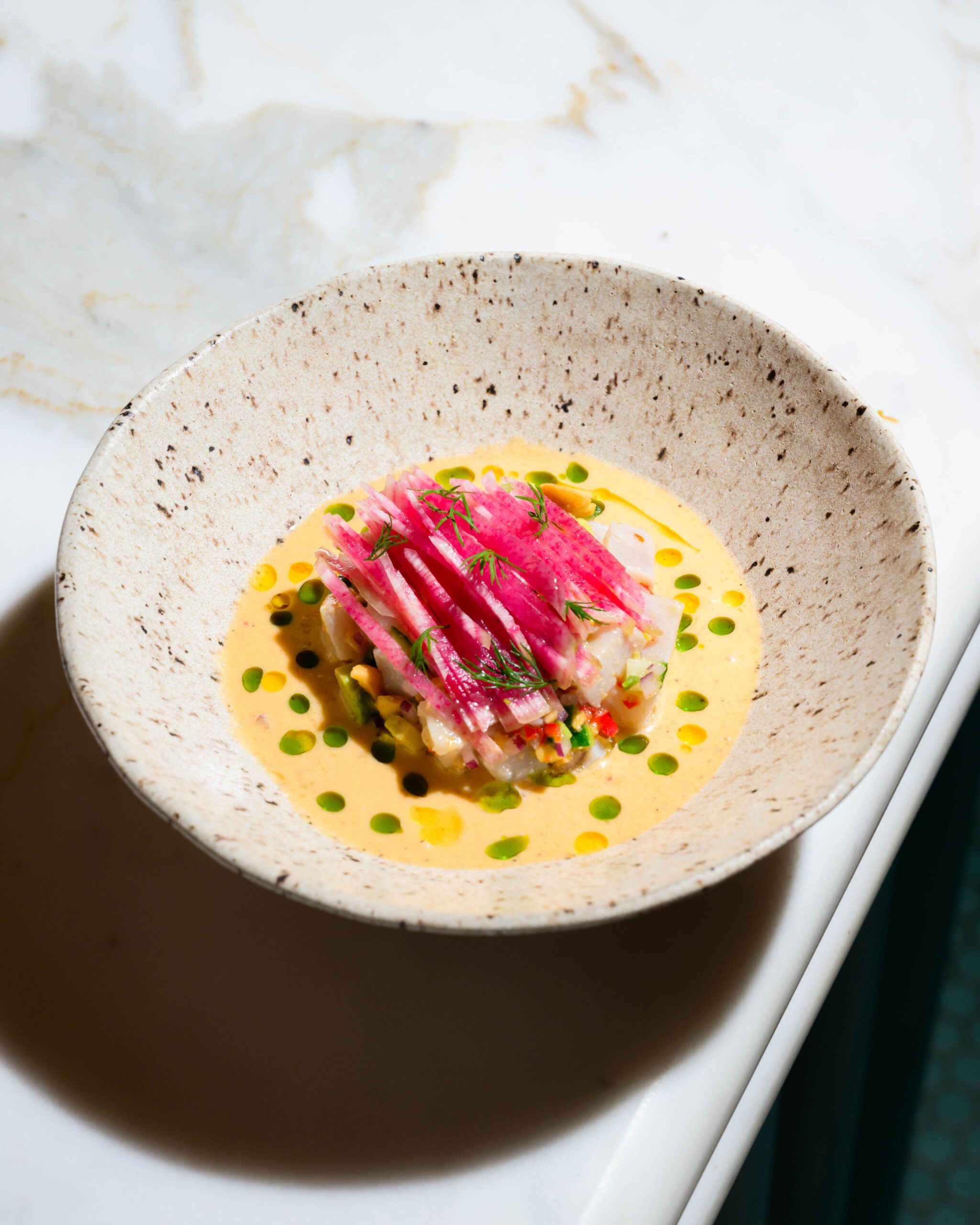
Cotoa’s Mahi Mahi Manicero is a reinterpretation of the classic Ecuadorian hipijapa peanut ceviche, served with a creamy coconut and peanut sauce, cucumber, avocado, and radish.
From working in the food industry as invisible workers to sharing their culture only within close-knit community networks, there are many reasons why Ecuadorians and their cuisine have not received enough exposure in the United States. The role of food media, which has historically favored only a narrow range of Latin American cuisines, and the Ecuadorian government’s limited efforts to promote the country’s culinary identity abroad, have also reinforced the cuisine’s quiet presence.
Still, there are countless voices like Guignanzaca, Espinoza, Cando and Wright-Lewis. In New York, Miami, and beyond, Ecuadorian writers, chefs, and families are creating their own culinary landscapes. Far from the spotlight, Ecuadorian cuisine continues to be a place of joy, refuge, and resistance, and its presence is becoming more visible as people begin to take control of how Ecuadorian cuisine is expressed.
As Ecuadorian-Americans move forward, the question is no longer whether the cuisine is noteworthy. It’s about whether the rest of the world is ready to recognize what has been there all along.
