


Many modern delicacies didn’t have fancy beginnings. Caviar is considered a peasant food, In the 12th century, it was mainly eaten by Russian fishermen.. Maine lobsters were once called the “cockroaches of the sea” and were often fed to prisoners and used as fertilizer. It was only in the face of lobster’s rarity that we began to admire its buttery flesh and the flavorful salinity of sturgeon roe. But in the lexicon of edible luxury goods, there is one thing that has remained unwaveringly luxurious through time. It’s edible gold and silver.
These consumable precious metals were revered in ancient Egypt, Rome, Persia, South Asia, China, and Japan. Today, chefs all over the world are decorating. Seaweed wrapped jamon ibéricobirthday cakeand hamburger Glittering golden leaves. At the infamous Salt Bae’s Nusr-Et Steakhouse, 24k gold coated tomahawk steak. However, taste has little to do with this enduring appeal, as neither silver nor gold has a discernible taste. So why have we been suffocated for centuries by ingesting substances used in jewelry and tooth fillings? It starts with a little mysticism and a little medicine.
“The use of edible gold and silver is an ancient practice rooted primarily in the belief that these metals have medicinal and even immortal properties,” explains food historian KC Highsmith. As early as the 5th millennium BC, alchemists in Alexandria, Egypt, were developing elixirs made from liquid gold that they believed would purify and rejuvenate the body. Ayurvedic medicine has long praised silver’s therapeutic and antibacterial properties. and wealthy families in medieval Europe. gave their children silver spoons to suck on Some argue that this is to fight infectious diseases, which gave rise to the saying, “born with a silver spoon in your mouth.”
The “perfect” nature of these two elements, their high resistance to corrosion and oxidation, has led many to believe in their restorative properties for centuries. Science admits that Potential anti-inflammatory properties of gold and Antibacterial properties of silveringesting them directly is definitely a waste. That’s because edible silver (also known as 100% non-ionic bioactive silver) and gold (over 23 carats) are both biologically inert and pass through your digestive system and pass straight down the toilet. This also makes them non-toxic.
Gold and silver leaf are made by melting metal into rods, then rolling them with a machine or pounding them by hand to form sheets approximately 0.0001 mm thick. Other metals and alloys, such as copper, are often added during the manufacturing process to strengthen metals used in crafts and construction, but this makes them unsafe for consumption.
Surprisingly, imitation gold and silver mixed with varying levels of copper, zinc, aluminum, and other non-edible metals are sold as edible. Online retailers such as Amazon. Founder Albert Hsu Barnabas Blood GoldA gold and silver leaf producer based in Hong Kong told me that the technical way to tell the fake from the real thing is through the flame test.Real gold doesn’t burn, but imitations do,” he says. Barnabas has been selling products online to chefs and bakers for 20 years (in fact, Regular Content Roster of Collaborators), Sue has developed an insight into fakes. But for those not in the industry, identifying counterfeits can be difficult. “The safest bet is to choose a brand you trust, especially since these suppliers have gotten better at making fakes that are difficult to identify,” he explains of this golf leaf, which sells for as low as $6 and up to $17 on Amazon.
According to Soo, the biggest clues are often in the product reviews and price. If it looks cheap, it probably is. He is concerned that the prevalence of such fakes poses a risk to both consumers and the heritage of edible metals. “Many chefs and bakers are unaware that these counterfeit products exist and that using them can pose a real health risk to their customers,” he says. “Raising awareness helps protect both professionals and consumers and maintains the integrity of the technology.”
Edible gold and silver leaves were brought to the region by the Mughals and have long been common in South Asian cuisine. But it’s edible silver that adorns a variety of the region’s sweets, including fluffy barfi, sweet laddoos and nutty kaju katri. The use of varak, as these precious metals are known here, dates back to the textile craftsmanship of Jaipur’s royal family in the 18th century. Royal demand drew skilled artisans to the city and cemented its reputation for high-quality production, explains Mita Kapur, founder of Jaipur-based literary consultancy Siyahi. Over time, varakku became an important garnish of Indian sweets and food, moving from a pure royal craft to a widespread cultural tradition. Although it is still used in some high-end traditional costumes, “recently demand from the food industry, especially mithai and mishti shops, has far outstripped other uses,” says Kapur.
At Huso, a caviar-focused fine dining restaurant in Tribeca, two-time Top Chef winner Buddha Lo applies a similar ethos to gold plating.
Valak was the territory of a particular community of Muslim artisans called Panigars, literally meaning “foil makers.” “They have mastered this skill over generations and you can still find them working in the Panigalon Ka Mohalla area, where almost all the Panigars in the city are located,” explains Kapur. They were hammered out of silver or gold sandwiched between the pages of a small book-like device called an ausar, whose pages were made from the skins of sheep or goats.
About a decade ago, this age-old tactic became a dog whistle for India’s Hindu nationalist Bharatiya Janata Party (BJP) to continue its polemics against the country’s Muslim minority. In 2016, members of the BJP initiated a ban on “homemade” varak. According to their argument, report National Herald journalist Prabhat Singh claimed that Valak was not a vegetarian as he used “animal intestines” in the hammering process. Panigars challenged this ban in court, arguing that they only use washed and processed cowhide. A court later blocked the ban, but the damage had already been done. According to Singh’s report, the Bharatiya Janata Party’s onslaught on Panigarh has left around 150,000 varak artisans losing their livelihoods in automated factories. Still, Ms. Kapoor feels hopeful. “New practices are being established to teach and encourage artisans, and efforts are being made to preserve crafts. But it’s a complex battle between adapting to the new and preserving the old,” she explains.
Over the past five years, artisans in Kanazawa, where nearly all of Japan’s gold leaf has been produced since the late 1500s, have become a center of attraction for tourists. “The history of Kanazawa gold leaf reflects Japan’s cultural and economic evolution,” says Kenta Moroe, founder of Kanazawa-based gold leaf company Golden Valor. According to the story, in 1593, it was Toshiie Maeda of the Kaga domain who ordered the production of gold and silver leaf for military and ceremonial purposes, using an ancient technique called “enzuke,” in which metal was hand-hammered between washi paper made from gampi fibers, and promoted the Kaga domain to become the number one producer of these precious metals among cities in western Japan. Moroe explains that while the industry grew due to mechanization and demand during World War I, it was only after the war that the use of gold and silver expanded to food products. Currently, Kanazawa accounts for over 99% of Japan’s gold leaf production.
Moroe also explains that an automated process known as tachikiri was born in the 1960s to enable mass production, allowing for the widespread use of more affordable edible metals. However, efforts were made to preserve the yenzuke. In 2020, gold leaf with yen was registered as a UNESCO Intangible Cultural Heritage. Now in the city of Kanazawa, gold leaf soft serve ice cream and Decorated Japanese sweets (Japanese sweets)millions of tourists flock to this city every year.
Surprisingly, imitation gold and silver with varying levels of copper, zinc, aluminum, and other non-edible metals are sold as edible.
Perhaps the most elaborate use of edible gold occurred in New York City in 2004, when chef Joe Calderone entered the Guinness Book of World Records for serving the quirky Upper East Side dessert parlor Serendipity 3. the world’s most expensive sundae. The Golden Opulence Sunday was a single serving, had to be ordered 48 hours in advance, and cost $1,000. “It was the 50th anniversary of Serendipity, so we had to do it big,” he told me. Twenty-three carats of gold, valued at about $200, cover Tahitian vanilla ice cream, almonds, a golden goblet and a decorative dragee candy that frames an orchid molded from sugar that takes at least eight hours to make. Even though the price of gold has nearly doubled since 2004, Sunday still costs $1,000.
“We put a lot of thought into this sundae, including freezing it to give it an extra five to six minutes of shelf life,” Calderone explains. He admitted setting world records was the main motivation for adding the sundae to the menu, but he never expected it to be so popular with customers. “We had no idea how this would be serviced, but as soon as the news broke, we started getting inquiries almost every day,” he says. Calderone said Sunday sold about 40 copies in its first year of release. Demand continues, with guests ranging from a father celebrating his daughter’s law school graduation to a Saudi prince who ordered several and paid in cash to a woman who just survived breast cancer.
In 2007, Serendipity 3 broke its own record with an even more extravagant feast (along with lots of gold, of course). Frozen hot chocolate sundae, priced at $25,000which inadvertently heralded the arrival of the Gilded Age of food. It happened at the beginning of Instagram hell that would forever change how we eat and where we eat. In the years that followed, restaurants began adorning regular items with gold, hoping for internet popularity rather than taste or quality.
In 2016, the now-closed modern Japanese restaurant KOA in the Flatiron District opened. The world’s most expensive ramen costs $180 It comes with gold-leafed Wagyu beef and a heaping pile of shaved truffles. In the same year, the Manila Social Club made a donation to New York City. gold coated crystal champagne donut. Just a few years later, in 2018, Ainsworth, a high-rise sports bar in midtown Manhattan, was making sales. $45 for 10 gold-plated chicken wings. But Calderone is not impressed. “They’re taking something mundane and throwing money at it. They’re not taking something elaborate and throwing money at it,” he says with a snort.
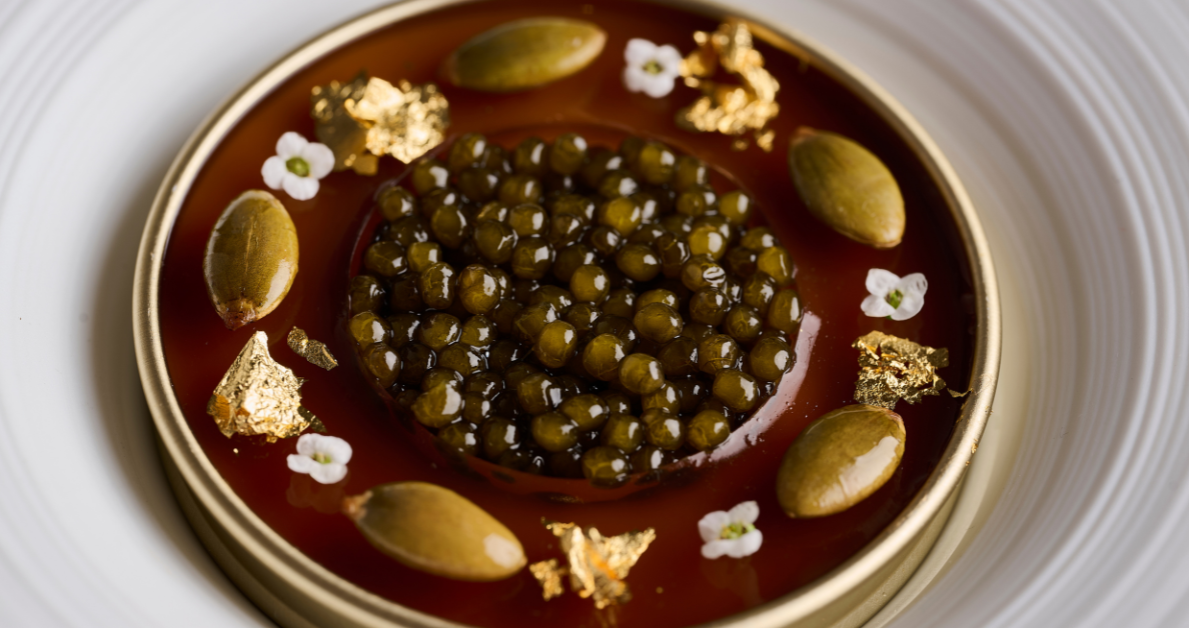
At Huso, a caviar-focused fine dining restaurant in Tribeca, two-time Top Chef winner Buddha Lo applies a similar ethos to gold plating. “It’s about taking something great and amplifying it,” he explains. Lo’s current fall tasting menu includes; first course Featuring precious spot shrimp and mounds of plump, shiny Kaluga hybrid caviar surrounded by a delicate garland of edible gold leaf. “I use it sparingly and with purpose, usually when the dish already has a classy feel and subtle accents of gold add visual contrast and a festive feel.”
Apparently, that has been the central appeal of edible gold and silver from the beginning. It’s about marking the extraordinary and enjoying the exquisite. And for those who can’t afford a $25,000 sundae, a $20 glittery gold flake on top of an ice cream cone allows for the illusion of innocent excess, even if only for a moment.
